
(Copyright Coxhoe Local History Group)
Billy Etherington, former postman, local newspaper reporter and avid cricket supporter recalls his memories of Coxhoe .
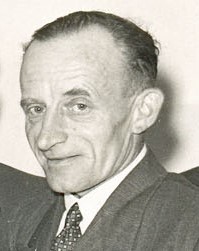
It was a chance meeting with an old school friend whom I had not seen since before the war that set us thinking of our younger days and how things have changed in Coxhoe since then.
Bill B….. he may not wish me to mention his name has been a bit of a roamer and had travelled far and wide over the past 25 years or so in England and also abroad. He was commenting on the fact that Coxhoe has changed so much since he was here last and that it is not now the Coxhoe he had known in his youth.
In the years before the 1939 – 45 war when there was no television and perhaps not so much radio, local activities were much more pronounced and he was recalling the time when Coxhoe held its annual Aged Miners Gala Day, with Kelloe, West Cornforth & Tursdale. This was usually held near the Avenue , Coxhoe ( which has now been converted into a housing estate) and attracted visitors from far and wide. This was preceded by a parade from which went around the village from Coxhoe Bridge Station and ended at the Kicking Cuddy in Durham Road.
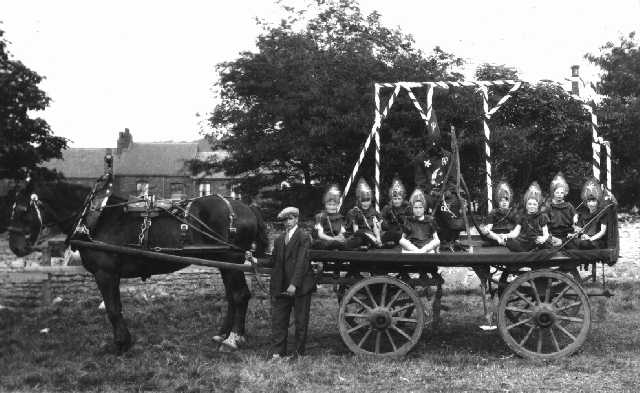
Prizes were awarded for the best decorated shop en-route and many others for the best decorated cars, floats, ponies, original and comic dress and so on.
In the field itself which was pretty large there was always a host of side shows and among many other things there would be a foot handicap, sports events for the school children, a contest for jazz bands in all their fancy uniforms (a very popular event), a Gymkhana with musical chairs and other games on horseback and all the time music would be playing in the background fro the Coxhoe Silver Prize Band. The events usually took up all day Saturday and also Monday evening.
We were always anxious for a nice day and on the whole were very fortunate. It was a usual thing to see school kiddies helping the showmen to erect their side shows just to get a free ride on the roundabouts.
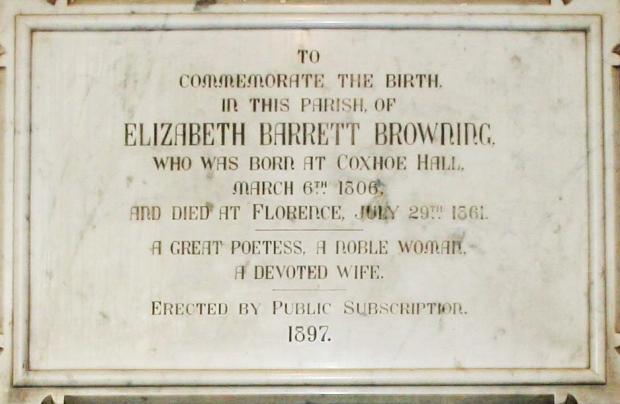
I pointed out to Bill that you cannot stop progress and that this sort of thing has faded out from many other villages besides Coxhoe and so then he went off on another subject. “Where are the old walks in Coxhoe that we used to enjoy on a Sunday evening” he said. I can remember going from Coxhoe Bridge along the road to Coxhoe Mill Farm and around Coxhoe Hall road, a very popular walk on a Sunday evening. People used to sit on the banks and watch the rabbits on the banky field, there must have been thousands of them. Now they have all gone and so has Coxhoe Hall, the birthplace of Mrs Elizabeth Barrett Browning the poetess.
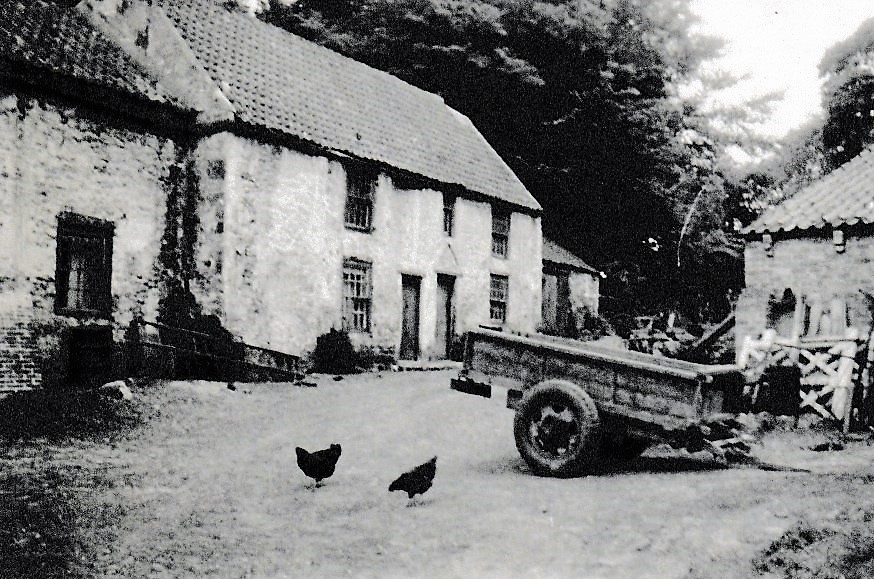
There is nothing left, even the trees have all been felled, true there has been some replanting of young trees but it cannot be the same in our life time. This made me feel very sad, I can still remember the first time I had to go to Coxhoe Hall on an errand for someone when I was very young. The Hall then had a lodge at the first gate, another in the grounds, one for the gamekeeper in the valley where the rabbits were and another for the gardener near the East House Farm.
Everything was so trim and neat in the grounds with lawns beautifully kept and flowers in abundance. I felt a little nervous when going to the front door and hardly dare pull the old fashioned bell which seemed to peal away in the distance. I need not have worried although the suits of armour in the doorway seemed to be so menacing I was treated just like a V.I.P. and sent on my way.
Another memory of these days was when Mr J. Wood J.P. held an open day with women folk from the village having tea on the lawns and tennis and croquet being played. I stole away to look at the cars in the garage when the chauffeur showed me the 1921 Rolls Royce which he was looking after, besides the other two there was the penny farthing bicycle, but I was too small to do anything about that. There was also a green house, a piggery nearby and a host of things to interest the small boy. Now there is nothing left but ruins. The young trees may cover this in time but it will be quite a while before that happens.
It was Jimmy the porter at Coxhoe Bridge Station, who first told me the story about Mrs Browning the poetess. I used to go to the station to watch the trains (we had a passenger service in those days) and he had an old newspaper cutting which he was proud of and he could tell a good story.
There had been some mystery about the birthplace of Mrs Browning, and much speculation among person interested in literary history but the parish register at St Helens Church, Kelloe set the questions at rest.

Miss Elizabeth Barrett Moulton Barrett was born at Coxhoe Hall on March 6th 1806, and on account of the infants uncertain condition of health was privately baptised by the then vicar, the Reverend George Stephenson, at Coxhoe Hall. Thus she was only “admitted to the Church” on the occasion of the baptism of her brother Edward Barrett Moulton Barrett. The latter was born on June 26th 1807, and his baptism at Kelloe Church took place on February 10th 1808, Elizabeth then being two years old. The ceremony of “receiving” consists mainly of the reading of prayers, the presiding clergyman raising the “admitted one” over the font.
From there being no signatures attached, and nothing but the entry of the facts in the briefest form, and in the same clerkly hand that has made the entries both above and below, the register of Kelloe Church is only important as containing trace and proof of the residence in the district of the Moulton Barrett family.
The record as it elates to Mrs Browning reads thus… “Elizabeth Barrett Moulton Barrett, first child of Edward Barrett Moulton Barrett Esq. of Coxhoe Hall, a native of St. Thomas’s, Jamaica, by his wife Mary, late Clark of Newcastle, born March 6th 1806, and admitted February 10th 1808.”
The Barretts occupation was only temporary. They went immediately after the marriage of Mr Barrett and Miss Clark in the year 1805, and in 1809 the family removed to their Hertfordshire home, and all connection with the North ceased.
There is a commemorative plaque in Kelloe Church which was unveiled by the very Reverend Dr. Kitchin, Dean of Durham on Tuesday 7th September 1897 to the memory of Mrs Browning. This caused considerable interest at the time, and many people were present from places far distant from Kelloe, as well as many from the district. I am indebted to a local resident in Coxhoe for my information, who loaned me some old cuttings, which gave the facts as they were recorded at the time.
Coxhoe Hall was built around 1725 by a Mr. John Burdon on a site which was previously occupied by the ruins of an old Catholic Chapel, whose history is unknown. The site is believed to have been an important point in connection with the Roman encampment below, and the terraced construction of the grounds surrounding it, together with the land on either side up to the crest of the ridge, justifies the assumption. Old remnants of masonry had been found at the time to bear this out.
When Mr Burdon commenced building the Hall, he brought a gang of Italian workmen to work on the internal decorations of the various rooms, and these workmen have, or had, left ri9ch specimens of their handicraft, not only at Coxhoe, but also in the ornamentations of Aykley Heads, near Durham.
Coxhoe Hall faced south, and its architectural design was the castellated Gothic. It was a three storied structure. The ground floor had a billiard room and three reception rooms, whilst in the two storeys above were the morning room and some twenty bedrooms. The carving in the reception rooms was extremely rich with handsomely modelled brackets, cornices, etc, to claim the attention, and overhead the ceilings were very elaborate. The ornamentation was in the florid Italian style, mixed with a few classical modellings. The fireplaces merited special attention in the drawing room it was of carved wood figures with floral wreaths and shells with the Burdon Crest ( a squirrel) taking the centre place. Cunning hands must have been at work to form the intricate curves of flowers, fruit, and stalks, which were the leading features.
A more beautiful specimen of its kind did not exist at the time, at least in the County of Durham. The marble staircase was a fine example of highly decorative work, and in the bedrooms the same florid architectural design had been carried out; with coloured marbles, more or less ornamented had been employed in the setting of each fireplace.
The west side of the Hall was also very striking, and overlooked the tennis grounds, which was surrounded by ornamental shrubs; and behind was a terrace, which possessed Roman relics, and had been beautified by flower borders and rustic seats. The extensive grounds attached to the hall were laid out with great taste, and the road from Coxhoe Avenue to the Hall was tree lined all the way.
The best view of the Hall was from the walk from Coxhoe Bridge Station, and also from the trains going in the direction of West Hartlepool, it appeared to be peeping from the midst of luxuriance of foliage, and the Gothic outline shown to the best advantage.
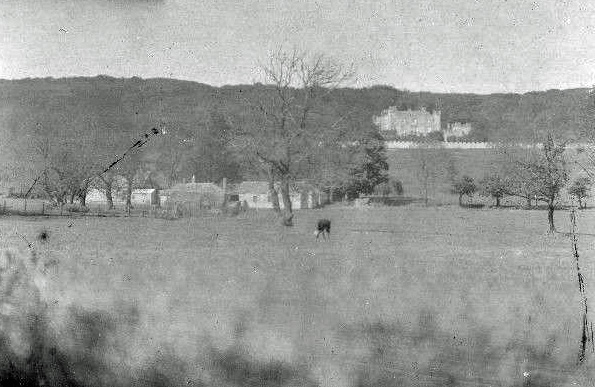
When Mr Burdon left Coxhoe, he took up residence at Hardwick Hall, near Sedgefield, and here again he indulged his tastes to the utmost. His greatest achievement at Hardwick was the building of the Banqueting Hall, which is stated to have cost £10,000, a tremendous sum of money at that time. He appears to have been a great enthusiast for the arts an architecture.
Now, Coxhoe Hall is no more, after the deaths of Mr J.Wood J.P. and his sister Miss M.M Wood, the Hall was empty for a while; the army had it for a camp at the beginning of the 2nd World War, and I did not see it again until demobbed in 1946. Squatters had moved into the Army Huts, and they were there until re-housed in the Council Estates at Kelloe and Coxhoe. There was talk of making it into an Old Folks Home or hospital, or even a large welfare to serve the surrounding areas; but nothing ever transpired; but the fact is that the Hall gradually decayed, and vandalism did not help at all. After a few years of neglect it was demolished in the interest of safety, and some time later all the trees were felled, there must have been at least 15 acres of them; so now there is nothing left but ruins, which the young trees may hide in time, but it will be years before they can be anything like the original wood.
Many people in the area will remember the Coxhoe Hall road in their youth, it was a popular walk on a Sunday evening for many and at times got so congested that the local policeman came along to keep the road clear; as it was the only road to Kelloe and the Trimdons until about 1930, when a new road was constructed from the “Ladies Walk” gate to the new estates at Kelloe, and bypassed the Hall.
That is what Bill B…. missed most; there are still some pleasant walks left in the area; but it only depressed him to go round that way again after so long, and find such a difference. I suppose we have all changed a bit, walking is not so popular as it was; there are many other interests today and perhaps you don’t notice the change when it is spread over a number of years, and you are living in the district.
Both Mr. J. Wood and Miss M.M.Wood will be remembered for some time, they were always interested in local activities and played an active part in many; Mr Wood was one of the founders of the cricket club at Coxhoe, the earliest I can get back to is when Mr William Stokoe of Bowburn played for them in the year 1905, when he was a young boy, and the club is still going today.
Miss Wood played a part I the Women’s Institute activities, and helped a great deal when Coxhoe got the new Social and Literary Institute which was built in 1933. She also gave a considerable sum of money towards the addition of the Dance Hall and Supper Rooms which were completed in 1938. A plaque is on the Institute wall.
 Coxhoe Local History Group