
(Copyright Coxhoe Local History Group)
My Personal Recollections of a Childhood in the Early Fifties
My Parents, Edna and Billy Wheeler, moved from Cornforth Lane in 1949 to a house in The Avenue. My Dad,like many men in Coxhoe at the time, worked at The Basics.
I attended Cornforth Lane Junior and Infant School from 1949 to 1956. My memories of life there seem bizarre when compared to modern day childhood. In Infant School, after the lunch time break, we had half an hour in the classroom when we were supposed to rest our head on our folded arms and sleep. It must have been a godsend to the staff, who, no doubt, caught up with their marking. I well remember an incident with my teacher in the second year Infants, Miss Cook One day Miss Cook decided to correct my left handedness and insisted on me using my right hand. If I deviated and, surreptitiously, tried to use my left hand, I was treated to a quick rap on the knuckles with a ruler. I fled home at four o’clock in floods of tears. It was the only time my mother saw fit to call in to complain. Luckily the punishment ceased next day and I continued to use my left hand.
Miss Gale was the formidable teacher of Junior One. I seem to remember her sitting in a high, old fashioned teacher’s desk. She had a cutting tongue and did not suffer fools. I tried to keep my head down to avoid notice but I do remember the humiliation when I was made to stand at the front of the class and expose my ignorance when I could not distinguish between “who” and “how”.
Mr Airey taught Junior 2. I think it was in his class that we were encouraged to take in a tin of polish and a duster. We were expected to polish our desks and I was very proud of the finish I achieved on its surface. Pride goes before a fall and some boy at the back of the class misbehaved. He was promptly moved in my place. His desk had not had the loving care which I had bestowed on my original desk and, to my chagrin, I could not achieve a similar finish to the second desk, despite my efforts. My interest in housewifely tasks ceased thereupon and they have never been subsequently revived.
Miss Slater, who later married Mr Davidson, a teacher in the Seniors, was my teacher in Junior Three. She tried to introduce more modern methods into her teaching to engage our interests. I remember contributing the figure of Sir Francis Drake to a frieze of the Armada she organized which was installed on the wall of a classroom in an outside building close to the kitchens. She also had an aquarium which at various times housed stickle-backs and newts.
Mr Tony Potts, the nephew of the headmaster, Mr Potts, taught Junior Four. He organized a class play for Easter called St George and the Dragon which was very exciting. Obviously Tony ably recognized that I had no dramatic ability and I was relegated to being a medieval lady watching the proceedings. I was very conscious of a long, conical hat decorated with flowing material which my mother made for me and which I wore with difficulty. I thought I was the “bee’s knees” but could not even manage this lowly role as I was reprimanded for not paying sufficient attention to the play in hand. I was more intrigued by the audience. During this year we had lessons on classical literature by Mr Harry Mears who terrified me. We had to study excerpts from Dickens and I remember not understanding the language. He used to pounce on you to deduce the meaning of obscure words from the context of the passage. I did not excel at this. ( Little did I realize that ten years later I would associate with Tony and Harry in a professional manner on the other side of the classroom desk, so to speak.)
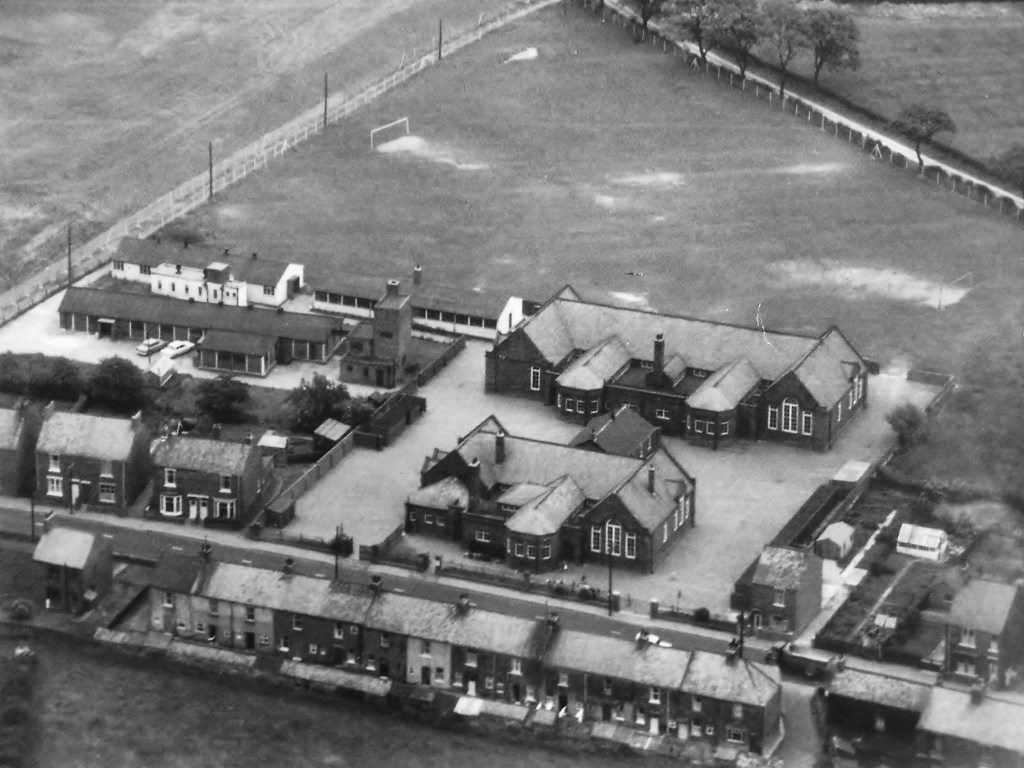
The kitchens did a good service in providing sustaining food at lunch time. My great aunt, Mrs May Bell who lived at 10, Foundry Row, worked there so I often gave her a little wave for reassurance. Surprisingly I developed a liking for their smoked haddock which I certainly did not experience at home The Dining Hall, close by, was utilized at Xmas for the Xmas Party. We brought in food provided by our parents but it must have been a reflection of my mother’s cake making abilities that my offerings somehow always ended on the teachers’ table.
I remember at some stage Mr Potts, the headmaster, organizing a band. My musical ability was comparable to that of my dramatic capabilities. I was assigned to the cymbals but still felt important. Another event , annual in occurrence, was that of the Nit Nurse. I remember the long line waiting for the rough inspection and the ignominy if anything was located.
One of the “in” activities in the playground was the display and swapping of choice buttons from individuals’ Button Boxes. I tried to join in but my mother would only donate a few uninspiring buttons (traditions of hoarding still lingered from the war and one never knew if there would be a need in future) and so I couldn’t participate or compete as no one wanted to swap for my miserable specimens. Lunchtimes were an invitation to moonlight or flit off for half an hour. There were gaps in the hedge at the opposite side of the school field so we easily slipped through to visit friends’ aunties and grans. In the springtime we used to borrow jam jars and venture down to the beck near Cornforth to go taddying- tadpole collecting. Staff turned a blind eye and must have known about it since we reappeared with tadpoles. I am sure this would be a sacking offence today.
My father was a great walker and I used to accompany him around the area. He instilled a great love of nature and particularly that of wild flowers. Every year I participated in entering a wild flower collection into the class competition. Now politically frowned upon and blamed for the demise of native varieties, I think wild flower collection got a bad press. It motivated children to explore their environment( although we did not need any encouragement), and increased their knowledge. I think pesticides and changes in land management and farming techniques contributed more than children picking a few flowers. Different areas around Coxhoe are associated in my mind with wild flowers.
I pestered my mother in Spring to be given permission to search the Quarry Banks for cowslips. Ox-eyed Daisies lined the roadside fronting the Quarry Banks whereas Milkmaids were only to be found on the boggy land beside the beck flowing from the mill towards the railway station. We often walked along the path fronting Coxhoe Hall. My mother used to comment that it was a favourite spot for courting couples in the thirties and a policeman was employed moving them on. Of course it was used as a camp for Italian Prisoners of Wars who reputedly trapped the rabbits on the meadow land in front of the Hall. It was rumoured to have a ghost and I once spoke with someone who was stationed there after the war and, without prompting, he remarked that he had seen a ghost in the room above the porch.
I remember sheltering with my father in a rainstorm under the porch and wondering why there were plans to demolish such an interesting building. Unfortunately many fine buildings were demolished without thought in the fifties. Other favourites were the Ladies’ Walk which connected the Hall with the Quarry Banks, The Trews, somewhat overgrown even in the Fifties, which lead from the Quarry Banks to the Long Row and where my father apparently proposed, and the Hills and Holes near Cornforth Quarry. The old railway line from the Old Mill to Kelloe was the location for bilberry picking and I still yearn for a taste of the bilberry pie my mother used to make. Modern day blueberries do not come anywhere near such bliss. Another pastime in the early fifties was rose hip collection.
This was a way to augment pocket money. You had to pick a large sack before you were compensated. I was soon introduced to a way to increase your collection more speedily. Pick green hips and hide them at the bottom of your sack and hope to evade detection during quality control inspection. Rose hip syrup was never a favourite remedy of mine anyway. Unfortunately many of our local walks were spoilt in the mid fifties. The Quarry Banks were covered completely with lime slurry, destroying all wildlife and then it resembled a moon scape.
The banks below the Hall- wild flower meadow land grazed for years by cows- were ploughed up for arable and only recently have they reverted to pasture, losing the variety of flowers in the process. The path from the old Mill was concreted and used by lorries spoiling the peace and tranquility. I felt it was wrong in the fifties. In these conservation –minded times I am sure it would not have been allowed.
I was a great tomboy and I used to roam the area with my friend, Roy Mahon, who lived a few doors away. At the top of the Avenue was the area known, for obvious reasons, as the Logs. Here older children had fires and we used to acquire potatoes unbeknown from our Mams’ larders to roast. We used to build dens in the shrubby, overgrown plot at the top of the Avenue which in the late 1800s used, I think, to be known as the Square. These we fought battles over with other marauding gangs of children. I remember one den being under siege from fluttering moths. I was dispatched to the chemists at the bottom of the Avenue to obtain a deterrent but the only available fly killer proved ineffectual and I was mocked for my useless purchase.
We used to use rollers skates as a means of transport but not in the convential way. We placed a piece of board across two skates , sat down and promptly launched ourselves from the top of the Avenue and let gravity be our means of propulsion. Later we progressed to bogies or trolleys which were equally unsafe. It obviously highlights how little traffic used that road in the fifties. And to think my mother wouldn’t let me have a bike as the roads were too dangerous. Going out to play on a Sunday was frowned on. I can once remember being allowed after Sunday School to go on a walk to my grandfather’s house in the Long Row but cautioned that I hadn’t to be loud, misbehave and certainly not dirty or damage my Sunday best clothes.
Although we were staunch Church of England, my Mother allowed me to attend activities organized by the two Methodist Chapels. The highlight for many children was the annual Anniversary Sunday when Methodist children performed poems, songs and readings in front of adoring parents. I was quite envious although I would have been totally inept and no doubt would have dried up in front of such a large congregation. The Primitive Methodists had dances for adults and children combined- no doubt not allowed these days. I also attended a children’s study group at the hall attached to the Methodists and remember studying each of the first Books of the New Testament. We had to answer questions on the contents and if successful were presented with an illustrated version of St John, etc. Not exactly dynamic by today’s standards.
Other highlights included the Annual Day Trip for Children organized by the Working Man’s Club. There was a queue of buses, usually waiting to transport children to such resorts as Redcar, Saltburn etc. One year I remember going by train to a seaside resort. The closure of the line probably led to local buses being used.
Bonfire night I viewed with a mixture of apprehension. Being based in the Avenue we were sometimes allowed to collect firewood and help guard the bonfire built on the Green in the Grove. There were several bonfires constructed in the Grove council house estate. Much plundering by rival gangs from each others’ bonfires took place as each gang competed to have the biggest and best in the area. I used to visit the Grove bonfire in the evening ,usually in the company of my parents for security, as the older boys were not averse to hurling Jumping Jacks around and they were unpredictable at the best of times.
Very early in the Fifties I seem to recollect a May Day parade where all the children dressed in fancy outfits and a May queen was elected. I seem to think it travelled up from the bottom of Coxhoe up the back lane in the direction of Cow Close and ended at the Recreation Area. I think I was quite young so don’t have very clear memories. Perhaps others can supply you with more details.
In 1956 I, unexpectedly, passed the Eleven Plus and continued my education at Durham Girls Grammar school. This was not customary as normally children from Coxhoe went on to Spennimoor. Since my parents set a great store in education being a stepping stone to advancement I was encouraged to leave my childhood behind and concentrate on homework. I seemed to have little real contact with life in Coxhoe after this as my friends and activities were centred more on Durham.
Eunice Spilman nee Wheeler
 Coxhoe Local History Group